
The Needle & The Damage Done
Sadly many myths about music making have been passed around so many times that they have taken on the seeming of truth. Most of these myths are more attractive to a certain mindset than the truth so not only do they propagate but people defend them, often very aggressively. I would like to open up many of these supposed truisms to the light of reason.
The problem is that these broken ideas lead to broken outcomes. People don’t get to achieve what they could. Because of this, they become frustrated. This frustration leads to more fantasy ideas taking root.
To understand, it is much better to have an open mind because many of the real truths require a very different mindset to understand. This “Yoda” mindset is the difference between making things happen and broken results.
On this page, I will list many of the common malformed ideas that are spread around and attempt to show the better path. I will update the page as I meet more of these dangers.
Why does this matter?
I guess we should address the usual responses and clear them so other ideas can be considered:
- It doesn’t matter, my making it matter is a sign of my wrongness: If it doesn’t matter, why are we so worried about it?
- Music making is a unique path so all ways are equally good: Sure. If the results are broken, the method must also be broken.
- Old ways are no longer relevant you have to follow the modern ways: Traditions develop for logical reasons. Necessity is the mother of convention and all that. New situations can raise the need for change, but that change should match the new situations, not simply replace them.
- Only Nazis make rules: Only Nazis scream at others when questioned about their views. If the idea or opinion cannot resist testing without knives and grenades then there is something wrong with the idea itself. See #2,
Music Making Myths Busted
Mixing is a Technical Process – if you get all the tips, tricks, & settings, anyone can win at it. This includes Presets, Templates, and Cheat Sheets. The idea that if you get the perfect settings you can copy & paste them everywhere is attractive but flawed. Mixing is an Artform so it cannot be learned by rote and applied like bunny ears in an Instaham camera – notice how those bunny ears do not make a real bunny. Every Song & Singer is unique, not treating them as such means that the material itself is not being worked on so the results can only be irrelevant. No one wants to listen to irrelevant songs as they have no story to tell. Also if every song sounds the same there is no purpose to there being more than one song in the world. We want new songs for new stories (or at least new versions of the I Luv U thing).
Advanced Mixing Techniques equal Better Mixes. The idea that more advanced techniques exist, and if applied will make the work more Pro-ful, is just silly. While some songs were delivered with/because of some unusual situation, this does not mean that duplicating that unique situation will deliver the same result, especially if the conditions are not the same. “Advanced” and “Pro” are merely a devious way of selling empty products to fearful people. The basics are what matters every time. Get the basics right and any unique situations will be solved. The solutions may be a bit different but they are not advanced, merely an extension of good basics to suit this situation.
Top Down Mixing, or Mixing into Limiters, Compressors etc. This seems like a really clever idea if you don’t yet understand the notion of Balance. The idea is that if you make your Mastering (and similar) decisions first then everything you do will sound amazeballs from the get-go because it is already perfect. It seems clever because you have decided what your Song will sound like before you even start. However, this is not how amazing happens as amazing happens when you follow where the Song needs to go and trust that. The greatest issue though takes a while to understand as it is about Balance. The quick way to grok this is to take the master processing off entirely and listen to what you have. If it sounds broken then you don’t have a working mix. This is why Mastering etc is done AFTER a great mix is already there.
Pink Noise Mixing and Reference Tracks. This is like above where we think of the end before we understand what we have. Easy to think we are the God of our songs but this is not the Mandalorian Way. Endlessly flipping back and forth against our favorite song or comparing to Pink Noise on a scope seems like a natty cheat as you can color by numbers your mix into perfectness by comparing and moving ever closer. Sadly again this is broken thinking as your Song is not the other Song and if it is then your song is not relevant. Mixing is about finding an enhancing what is unique about your song. While songs are similar, making them carbon copies is a great way to make them totally pointless. Mixing is Art, not formulas.
Studio Monitors, Room Correction, Wall Padding, and Speaker Emulations are necessary. While a nice room can be a help, these are not the cause of a good Song. It is fashionable to assume otherwise but the reality is that many wonderful records were made in situations that most forum-hounds would be horrified by. Look into Motown etc. All that stuff about having to have specific setups is merely avoiding doing the real work of writing and performing something powerful. Powerful work will transcend any technical limitations. It is easy to hide in false technicality but if there is no result, it doesn’t matter how perfectly perfect the speakers are.
Mixing in Headphones. Mixing in headphones like a Hipster looks tres cool on le DAW website but is plain poor practice. Headphones and speakers are really very different in how they propagate sound from driver to ear/brain. While that changed perspective seems impressive when listening to Dark Side Of The Moon, it is very dangerous when trying to mix. The word trying as most beginners fall for the headphone thing as they don’t want to pony for nice speakers – often saying that they can’t have em due to neighbors, wife, fish…
The reality is that experienced Mix Engineers work at the same sort of volume that (sane) people listen to their TV or music as they iron their hubby’s jocks. Therefore volume is a bogus argument. Mixing in cans gives such a false sense of space that most often a headphone mix seems great in the cans but explodes on speakers as space is wrongly perceived so echoes, reverbs, depth and even balance are plain broken when played “properly”. Mix on speakers, any speaker that you know well will do. You get to know a speaker from listening to great music like Dark Side Of The Moon for a long time so you can build that FEEL (not sound) as you work. As for headphone fix software Brrrrtttt. If that wasn’t clear, they are total BS to con fools out of coin they are not wise enough to spend on a copy of Dark Side Of The Moon instead.
Fancy Microphones and Shielding. While it feels very Pro to have an expensive mic wrapped in one of those shields, it is not only not necessary but contrary to good basic practice. Microphones are designed with a lot of problem-solving engineering built-in. Having the user meddle with that can only undo the hard work and problems solved. The idea is to match the microphone type to the situation. For most people, the best mic is a Dynamic (Shure SM57/58) as these are already set up to deliver very well in just about any situation, esp in live and ad-hoc situations. Condenser mics look very sexy and can sound great, but ONLY if you use them well. Otherwise, they sound worse. Putting mics in a shield or box made of cushions is not using a mic properly as it upsets the engineering that is designed to capture a great performance. Once a broken sound is recorded, it cannot be made to go away. The mic has recorded exactly what was happening: a broken mic in a cardboard box. No one wants to listen to that. Avoid USB mics, esp with the word Pro on the box. If on a budget, get the Behringer XM8500 + Audient EVO 4 interface as they perform wonderfully for a peanut price.
LOUD & W-I-D-E is better. While louder does seem better, it is not useful as an actual metric. Everything about mixing is Balance. Balance is always about being relative; this one seems big because those ones are small. If everything is loud and wide, then nothing is loud or wide. While it can feel like you have to be loud because everything else is loud, this is not the right mindset. If you are an Indie, you need to capture fans who want something special. Being just like… is not getting you there. Build Dynamic Mixes with plenty of ability to capture the listener with something engaging. Loud is only passingly engaging; after a few seconds, it wears off. Worse LOUD becomes annoying to many real music fans as the music is broken. Passion stays with people and draws them in. If you want your mix to feel wide, then turn off stereo wideners and work on your basic panning so that there is a great dynamic in how the instruments move around the space. Look also to your reverb and echoes to create depth as that works better than flat ‘n’ wide.
Guitars should be Doubled & Hard Panned. Nothing should be. These sorts of formulas are like Presets talked about above. Some songs sound great with that Judas Priest Twin Axe Attack, some do not. Punk and early Rap in particular used Mono to help deliver that raw sense of power. If you really do need wide guitars, then be sure that they are different takes. Never clone a track and pan it out with some sort of processing to fool yourself you done good. If your guitarist can’t play the same thing twice then make a feature of that with the power of mono.
Vocals Should be MeloTuned & Drums Should be Time-Edited. If the singer can’t sing and the drummer can’t drum, it is not the right time to be recording. A recording is a record of this act right here right now. If they sound like Venom then record them just like that (their fans love em). The best music is never technically perfect. I am watching a show with three amazing players and it is “perfect”. But at the same time every one of these players is controlling time, None of it feels like it is locked to a metrognome. Locking everything to the illusory safety of the grid (time & tune) is undoing the performance itself – stripping the song of purpose. What really matters is the passion. So long as the performer is focused on telling the Story they will control time and tune in a way that reflects the Story of the Song. This explains why singers like Lou Reed and Jello Biafra were so successful, despite not sounding like choirboys. Never strip the performance. If the performance is not worth recording, send the band out to practice, making sure they are practicing what matters. If necessary, bring in real session players (that is rarely Fiverrr Freddies – find real people).
Vocals can be recorded in fragments and pieced together later. The very best vocals are recorded like it is live – start to end of the song. While it feels very producery to record in fragments and stitch it all together, the resulting feel is exactly what was done so the Song itself doesn’t flow. Seeing the vocal is the bit telling the Story, if it is a fractured delivery, it is now a broken song. While compiling is indeed done by big bands, not only do they have a lot more experience, but mostly that compiling is done from among full song takes, not from single lines or words. If your singer is not ready, practice. Or have them throw it at the wall hardcore and see what happens. That requires trust and commitment but if committed, amazing can fall out. Take care, though, as if not committed, there will be lots of garbage that must be deleted ASAP, and you might even break the band if they’re not really ready. Your Record producer should know the difference; you must trust them.
Shortcuts and Macro-style Automation are good Workflow. McDonald’s is what it is because of the cookie-cutter nature of their process. We can enjoy that but we also know that to compete against McDonald’s an independent cafe or restaurant has to be the opposite of corner-cutting by delivering something unique and human – a far richer experience. When someone does things like reaching for some sort of auto time-saver that claims to do the “boring” or “hard” work for them, they are removing the human decision-making that defines a performance. If, for example, a vocal is auto-normalized, it no longer represents the nuance that the performer created in their performance. To assume that the performance variations are not part of the storytelling is to say that the human element is irrelevant. Fine if you are able to compete head-on with Maccas, but McFundgingly insane if you are an Indie. An Indie cafe has to be unique and characterful to attract those who don’t want McAverage fare. All the tiny decisions made (and not made) define this cafe and what they are. Do the real work -OR- accept that either a) your performer is not ready to record yet, b) mixing is not for you and bring in a specialist who is well suited to this work mindset, or c) accept that this will limit your final results in ways that are similar to McDonald’s vs a nice Restaurant. BTW there is a reason that there is a McStore in almost every suburb, as they know that people won’t drive far. Whereas a great restaurant only needs one location, people will drive a long way for that kind of special.
It needs to be Perfect or we Can’t Release it. Read what I just wrote about Venom. They sound like shite. But their fans love them. Same with Bathory and many Punk bands. Perfect is a great way of avoiding whilst seeming to be doing something that matters. The thing is that a Song only matters if it exists. Songs commonly belong to a time. If you stall them for months, years… chances are the song is not only overcooked but has lost relevance. Perfect songs, records, etc are never technically perfect. Rock is about passion, get that on-tape as directly as you can today and move forward. A great performance with passion for the Scene & Story of the Song beats anything. This is what real fans are looking for. Remember that if you get your basics right, everything else flows. Break the basics and everything is broken.
This Art, Scene & Story stuff is silly, my music just is. Everything has to have a purpose or it is without purpose. Pointless. While it is easy to make synth/guitar workouts, they don’t become music until they have been given a form and a purpose. These are Scene & Story. Story does not mean that there has to be a lyric like “I woke up Sunday morning…”. Story is another word for narrative. Narrative means that the work speaks something – a scene & story. Good Art does this, poor art does not. If you want people to notice and follow you, there has to be a great Scene & Story in your work. That can be anything at all really, but my advice is that the things that appeal and last best are things that speak to the human condition. Right now I am watching a Four Tops show. It is shmaltzy and mostly they are replacement singers but these schmoopy love songs have power that really moves the crowd. These songs are as good now as they were 60 years ago. That is great basics.
I have to do it all Myself or it is not genuine. I Can’t Afford to Work With People. I don’t think Frank Sinatra ever wrote a song. Does that make him a fraud? No. Bob Dylan wrote a lot of songs. Does that make him better than Sinatra. No. They are two very different artists, each with their own story to tell. In both cases they were never an army of one. One of the fundamental keys to success in anything is working with others. In music, we generally work with two sets of people our Backline and our Fans. While it is tempting to think that we start with fans, then get peeps to carry our luggage, it is actually the other way around. Work on the Backline first. This means developing relationships with people who are band members, studio people, venue people etc. While if you are only on the internet (and that makes it much harder and therefore more important to have a backline) it can seem that you should/must do everything yourself, it is a massive mistake more often than not. While good people do (and should) cost, a wise person works out how to pay in ways other than just cash. Build real two-way relationships where you reward those who help you to grow.
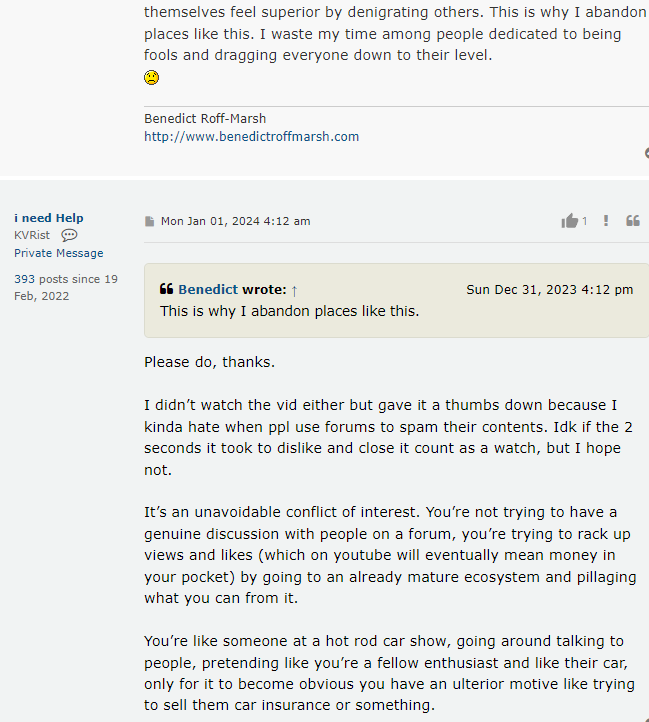
Crowdsourcing Feedback & Opinions. Getting feedback can be a very powerful thing. Someone outside of you can see/hear something that you didn’t and bring a missing part. Who you get this feedback and opinions from though is very important. Sadly most people in groups & forums are only there to a) have people tell them how amazeballz dey iz and b) to make other people feel bad so they can feel superior (see image). Neither of these are people who you should give the time of day. They are the opposite of Backline as they take from you and return nothing. Worse, they make you feel bad about yourself. Sometimes fan feedback can be valuable but all too often it is a way to be trapped. Bands that make bad records commonly do so because they are chasing the fans rather than making their own statement, eg compare Metallica’s “Justice” and “St Anger” albums. One is a powerful statement, the other is pandering. The people you need to court and pay attention to are those you truly respect because they have done good work (and that is not the same as popular – most famous YouBoobers I would not let near my work). Gene Simmons of KISS may not make music like mine, but once he understands what I am doing, his feedback should be worth hearing. If you don’t happen to have access to Gene Simmons, then consider paying a real Record Producer to give an opinion and advice. Many offer such a service, just be very clear what you hope to achieve and be really open to what they say as the way Rick Rubin says it may seem very different on the surface from what George Martin says, but underneath they may be saying the same thing. Be sure that you are not listening to yourself instead of the person you asked for advice. Their job is to point to the problems and possible solutions.
More & Better Gear makes Better Music. I won’t debate that a better guitar is probably easier to play and maybe has a marginally better tone – but not enough to make or break a career. So long as your guitar is in-tune, it is good enough to get you there. Adding 345 pedals and 14 racks of compressors will not make the songs any better. Matter of fact it probably makes the songs worse as the story now being told is about your gear collection and not about the girl you luv luv luv. No one cares about your gear. If that is all you focus on you are probably a Gamer and not really a musician. It is fine to be a Gamer, but understand that playing Gears of Gore does NOT make you a Navy SEAL, ready to infiltrate Outersocialismville where you shoot your way through a thousand Chuck Norrises. There is playing a game and there is doing Great Work. If assembling gear is your game then do that. If music is what matters then do that. There is a very minimal relationship between the two. Only get new gear when you need it – and that is never a step to becoming more Pro. The longer you use the same basic gear, the better you get with it. That is what counts. That is what most real professionals do.
Compression & Limiting will make things loud. While this is marginally true, it is also not really true in the ways that matter. Compression is mostly used (properly) in mixing to control dynamics. That can be to even out a performance but mostly it is to help emphasize the Groove. The compression may roll off some overall level as a side effect (which can be useful) but the real aim here is to enhance the feeling of the dynamic or groove of the performance. This makes the part/song feel louder which is great but it is not about simply making things louder in simple terms. This is often a hard thing for people to get but like all things Art, it has to be come at sideways.
Remember that mixing is not a technical process but an artform.
Compression is best used to make things more dramatic. If something is just too loud but not loud enough when you turn it down, assuming that you don’t have a balance problem, then Limiting may be a solution but be aware that limiting is making things quieter. It does this by limiting dynamic range so maybe you can turn it up and find a good balance. Also, consider clipping which lops off the loudest peaks so you can turn up the overall level. This does add distortion but that can be the very thing needed to help add brightness and excitement that helps pull that part through. There is no formula answer here as every mix is different, and again, if you have a balance issue elsewhere, fixing the wrong problem can only deliver a broken song.
Terms matter. The words that you use have power. Using the wrong words and terms means that you are undermining yourself. “I made a Beat and Dropped it” may seem uber cool to say, but what did your Freudian Slippers really just say that is uber dodgy? “I made a fragment of sound (a quarter of a bar of music) and abandoned it.” That is a very different meaning and outcome.
If you think it doesn’t matter because all words have the same meaning, why did our language make so many words that seem similar but really say something quite different? Because these things matter, we care a lot. Let me explain:
Bit & Sample Rates are similar to the above, where term creep and an attempt to seem cool have led to a kind of pseudoscience that is out there with worshiping turtles that hold up our flat earth by sacrificing babies whilst burning colored candles. It seems righteous to be all kinds of noble and use cray cray rates, but they don’t help. Worse, they hinder.
 Benedict Roff-Marsh